TCGPlayer vs eBay vs Courtyard: Best Platform to Sell Cards
TCGPlayer, eBay, or Courtyard — which pays more in 2026? Full fee breakdown, buy/sell strategy, and the 72-hour price-lag window most Pokemon traders miss.
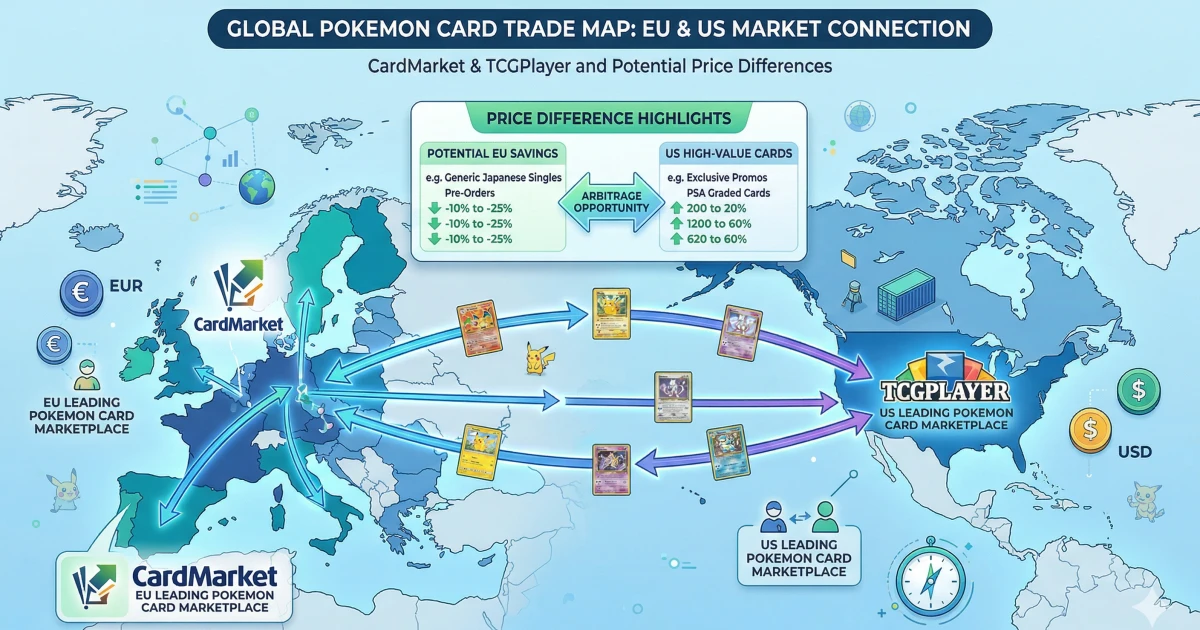
Umbreon EX is currently selling for $30–$35 on eBay. On TCGPlayer, listings for the same card in NM condition are sitting around $21. That ~40% gap is open right now — and it has been for days.
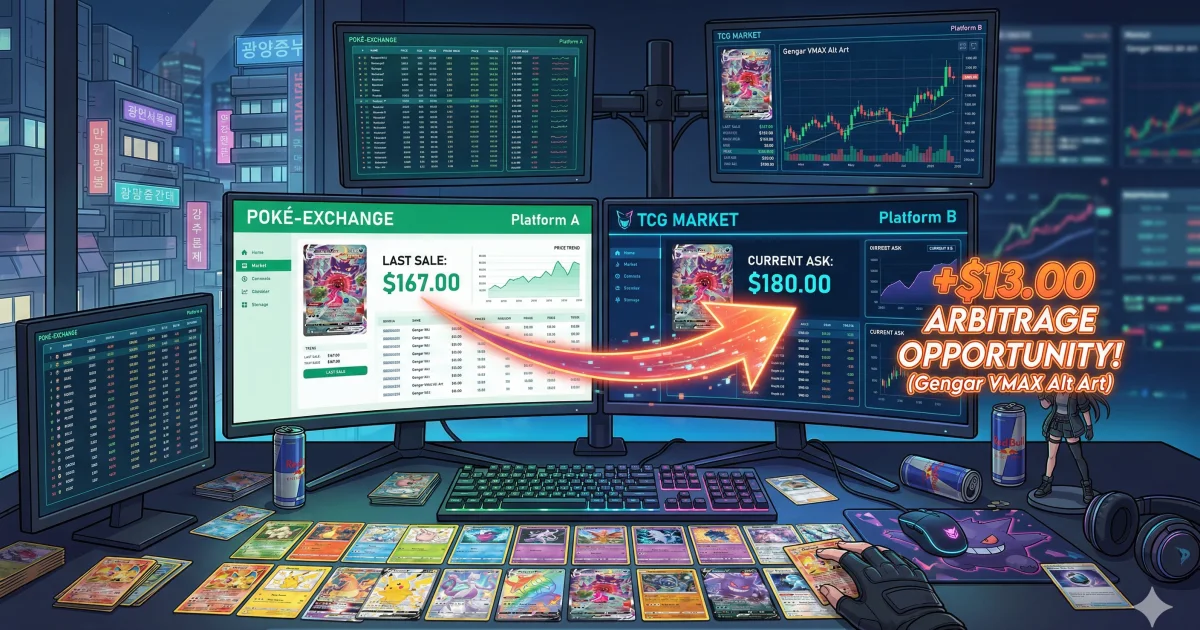
This isn't a one-off. When cards surge in price, eBay reflects it within hours. TCGPlayer and Courtyard sellers often take 24–72 hours to reprice. During that window, the arbitrage is obvious: buy on the lagging platform, sell where the price already moved. Right now there are over 300 active cross-platform opportunities in the Pokemon TCG market.
But knowing which platform to use for each side of every trade — that's where most traders leave real money on the table. Here's the full breakdown of all three platforms in 2026: fees, strategy, and the timing pattern most guides completely skip.
🔍 Find Live Pokemon Card Price Gaps Automatically → GapSense.uk
How Each Platform Actually Works
TCGPlayer is the largest dedicated trading card marketplace in North America. High inventory depth, condition-verified listings, and a large buyer base. For sellers, it delivers consistent volume — but the fees are significant, and pricing is determined by seller competition rather than real-time market dynamics.
eBay functions as the open market. Global buyers, auction dynamics, and faster price discovery mean eBay often reflects true market value before any other platform. It's where price spikes originate — and where the ceiling is highest for in-demand cards.
Courtyard is primarily a graded card vault and marketplace. Lower seller fees and a serious collector base make it the most efficient platform for BGS and PSA slabs — but liquidity is thinner for raw cards, and it's less useful for high-volume low-price flips.
Each platform has a specific role. Traders consistently generating profit aren't picking one — they're using all three deliberately.
Fee Breakdown: What Each Platform Actually Costs You
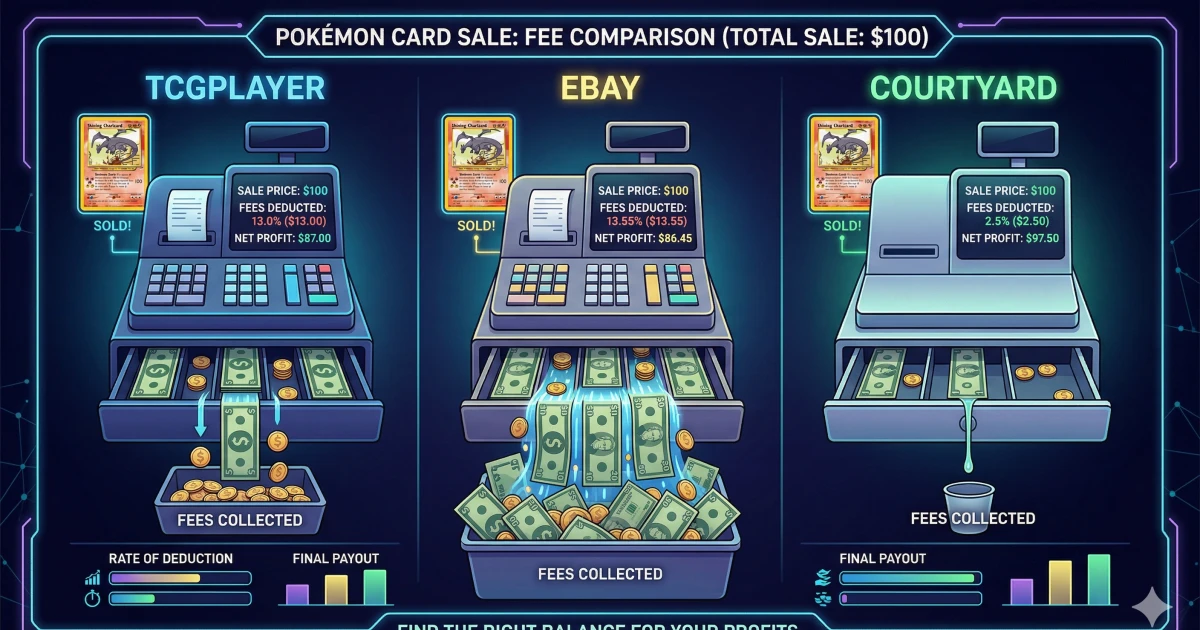
Most traders think in terms of sale price. The number that matters is net profit after all fees and shipping. Here's the real cost of selling on each platform:
| Platform | Seller Fee | Buyer Premium | Typical Shipping | Best For |
|---|---|---|---|---|
| TCGPlayer | ~12.55% | Removed (0%) | $0.69–$1.00 (PWE) | Raw cards, $5–$40 range |
| eBay | ~12.9% + $0.30 | 0% | $1.20–$4.00 | Higher value cards, auctions, graded slabs |
| Courtyard | ~3–5% | 0% | $0 (vault-to-vault) | Graded slabs $50+ |
The fee gap between platforms becomes decisive at higher price points. On a $100 graded card, Courtyard's 3–5% fee saves you $8–$10 compared to TCGPlayer or eBay. On a $15 raw card, that delta is barely $1.20 — almost meaningless. Platform selection matters more as card value increases.
The math on selling a $20 NM raw card on TCGPlayer looks like this:
- Sale price: $20.00
- Seller fee (12.55%): −$2.51
- Shipping label: −$0.80
- Net received: ~$16.69
Same card on eBay at $22 (reflecting a slight premium for eBay's buyer base): sale $22.00, fee $3.14, shipping $1.20, net ~$17.66. In this range, eBay only wins if you can actually command a higher sale price — not guaranteed on a common $20 card.
Where Should You Buy? The Buy-Side Strategy Per Platform
Raw Cards: Buy on TCGPlayer
TCGPlayer has the deepest inventory for raw cards. Competition between sellers keeps prices tight, and you can filter precisely by condition. For bulk sourcing — 5–20 copies of a card you're confident in — TCGPlayer's supply can usually fill the order at a consistent price point.
One underused tactic: sort by "Recently Listed" instead of lowest price. Sellers clearing collections sometimes price below market before automated repricing tools catch up. This is especially productive during the first 48 hours after a set releases, when new inventory floods in from people opening product.
Graded Slabs: Courtyard First, eBay Auctions Second
Courtyard's vault model means graded cards trade without physical shipping, keeping friction low and prices more rational. For PSA 10 and BGS 9.5 slabs in the $50–$300 range, Courtyard often has tighter spreads and more informed sellers than eBay's general marketplace.
For rare slabs with thin Courtyard inventory, eBay auctions surface better buy prices — particularly when auctions end at off-peak hours (weekday mornings, late Sunday night). Weekend prime-time auctions consistently close higher because more buyers are active.
Always Check eBay Sold Listings Before Buying Anywhere
Before committing to any buy, check eBay's sold listings for the last 30 days. Not active listings — sold listings. Active listings tell you what sellers want. Sold listings tell you what buyers actually paid.
A card with 20 active TCGPlayer listings at $15 but zero eBay sales in 30 days is a liquidity warning sign. You can buy it — but be prepared for a slow sell. This single step prevents more bad buys than any other habit in Pokemon TCG trading.
Where Should You Sell? Matching Platform to Card Type
Raw Cards Under $30: TCGPlayer Wins on Speed
TCGPlayer's buyer base is large, motivated, and trusts the condition system. For NM raw cards in the $5–$30 range, TCGPlayer consistently delivers faster sell-through than eBay. Buyers in this price range don't want to risk a private seller mislabeling condition — the TCGPlayer condition standard gives them confidence to buy without back-and-forth.
Cards Over $40: eBay's Price Ceiling Opens Up
Once a card crosses $40, eBay's global buyer pool starts to matter. International collectors, buyers who don't use TCGPlayer, and auction dynamics can push final prices above what TCGPlayer's listed market will sustain. For chase cards from new sets, this gap can be substantial.
When Umbreon EX surged 64.6% in recent sold data, sellers who had inventory listed on eBay captured the premium. Sellers with the same card still listed on TCGPlayer at the old price sold below market. The difference wasn't card quality — it was platform.
Graded Cards Over $50: Courtyard's Fee Advantage is Decisive
On a PSA 10 selling for $200:
- Courtyard at 4% fee: −$8.00. Net: $192.00
- eBay at 12.9% + $0.30 + $4 shipping: −$30.10. Net: $169.90
- Fee difference: ~$22 per card
For traders regularly moving graded cards, that $22 per card compounds fast. Across a 20-slab portfolio, you're leaving $440 on the table by defaulting to eBay. For more on where Courtyard specifically beats TCGPlayer on price gaps, see our breakdown of 5 hidden price gaps between Courtyard and TCGPlayer.
The 72-Hour Lag Window: An Arbitrage Pattern Most Traders Overlook
Here's what most platform comparison guides don't tell you.
When a Pokemon card surges in price — driven by a tournament result, a content creator pull, or supply shock — eBay reflects it within hours. TCGPlayer and Courtyard don't, for a simple structural reason: TCGPlayer sellers set prices manually. Most aren't monitoring eBay in real time. Courtyard vault listings are often set-and-forget. The result is a predictable 24–72 hour window where the same card sits significantly cheaper on TCGPlayer and Courtyard than it's actually selling for on eBay.
Current market data makes this visible at scale. Pikachu from the Mew set is showing a +115% price change on eBay while TCGPlayer listings lag 784% behind the eBay price. Darkrai from Darkness Ablaze shows near-zero movement on TCGPlayer while eBay sold data has shifted dramatically — a 4,189% lag in WEB3 price discovery. These aren't isolated flukes. Right now, 142 cards are showing active momentum signals with measurable platform lag.
How to systematically act on this:
- Track eBay sold listings daily on 10–15 cards you know well — focus on 7-day trend, not just the most recent sale
- When any card spikes 20%+ in a 24-hour window on eBay, immediately search TCGPlayer and Courtyard for the same card and condition
- If TCGPlayer still shows the pre-spike price, you have a buy window — typically 1–3 days before sellers reprice
- List on eBay at the new market price immediately, or hold for one week if the volume trend suggests the move will sustain
The risk: some surges are temporary. A card jumps on social media and corrects when supply responds. Volume is your confirmation signal — a card with rising sold count is a stronger signal than one with the same price movement on thin sales. Momentum signals with rising volume score meaningfully higher than those with static or falling volume.
This gap exists today. These opportunities close once enough traders notice them — so timing is the edge.
Platform Selection by Card Type: Quick Reference
| Card Type | Best Buy Platform | Best Sell Platform |
|---|---|---|
| Raw NM, $5–$20 | TCGPlayer | TCGPlayer |
| Raw NM, $20–$50 | TCGPlayer | eBay (higher price ceiling) |
| Raw NM, $50+ | eBay auction (off-peak hours) | eBay or Courtyard |
| Graded PSA/BGS, $50–$200 | Courtyard or eBay auction | Courtyard (lower fees) |
| Graded PSA/BGS, $200+ | eBay auction (off-peak) | Courtyard |
| Momentum/surging cards | TCGPlayer (during lag window) | eBay |
A Practical Three-Platform Weekly Workflow
Monday sourcing: Check TCGPlayer "recently listed" for 3–5 cards on your watchlist. Cross-reference each against eBay 30-day sold data. Only buy where the TCGPlayer price is at least 20% below eBay net-after-fees.
Wednesday listing: Cards you sourced on TCGPlayer that have moved upward in eBay sold data → list on eBay at current market price. Cards that haven't moved → relist on TCGPlayer at the current median to stay competitive in the algorithm.
Daily (5 minutes): Monitor for the 72-hour lag window. This is where automation gives a significant edge over manual checking. Running this workflow manually takes 45–60 minutes per session. Automated price gap tracking compresses it to 5–10 minutes of decisions on pre-surfaced opportunities.
For the logistics side — keeping shipping costs low when you're selling across platforms at different price points — the complete guide to shipping Pokemon cards without losing money covers which format to use at each price tier.
🔍 Find Live Pokemon Card Price Gaps Automatically → GapSense.uk
Frequently Asked Questions
Is TCGPlayer or eBay better for selling Pokemon cards?
For raw cards under $30, TCGPlayer typically delivers faster sell-through. For cards over $40 and graded slabs, eBay's larger buyer pool often produces higher final prices. In practice, use both — TCGPlayer for volume in the mid-range, eBay for higher-value individual sales.
Does Courtyard have lower fees than TCGPlayer?
Yes. Courtyard's seller fee runs approximately 3–5% versus TCGPlayer's ~12.55%. The advantage is most significant for graded cards over $50. For raw cards, Courtyard's thinner liquidity can offset the fee savings — factor in time-to-sale, not just fee percentage.
How do I find price gaps between TCGPlayer and eBay?
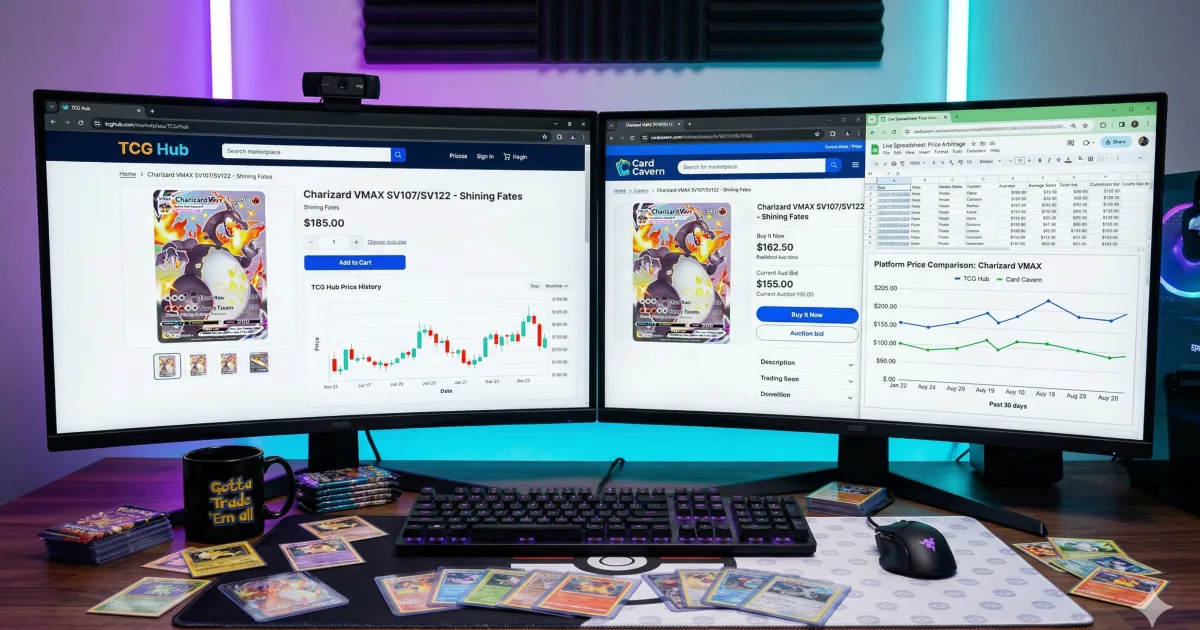
Manually: compare TCGPlayer median price against eBay 30-day sold average for the same card and condition. The gap minus fees and shipping on the sell side is your potential margin. Automated tools track these gaps in real time across hundreds of cards simultaneously — practical when you're running more than 10 cards at once.
Is buying on TCGPlayer to resell on eBay actually profitable?
When TCGPlayer prices lag behind eBay sold data by 20% or more, yes — especially during the 72-hour repricing window after a card surges. The critical step is calculating net margin after both platforms' fees and shipping before buying. A $5 gap on a $20 card can compress to $1–$2 net after costs.
What's the biggest mistake traders make on eBay?
Checking active listings instead of sold listings. Active listings reflect what sellers want to receive. Sold listings reflect what buyers actually paid. Always use sold data as your price reference — especially for cards where the last sale was more than two weeks ago.
Related Articles
Find Live Pokemon Card Price Gaps Automatically
Try GapSense.uk