Pokemon Card Fees: Which Platform Actually Pays More
TCGPlayer's fees are lower — but eBay often nets more. See the exact breakeven math by price tier, with real card examples and a 2-minute platform picker.
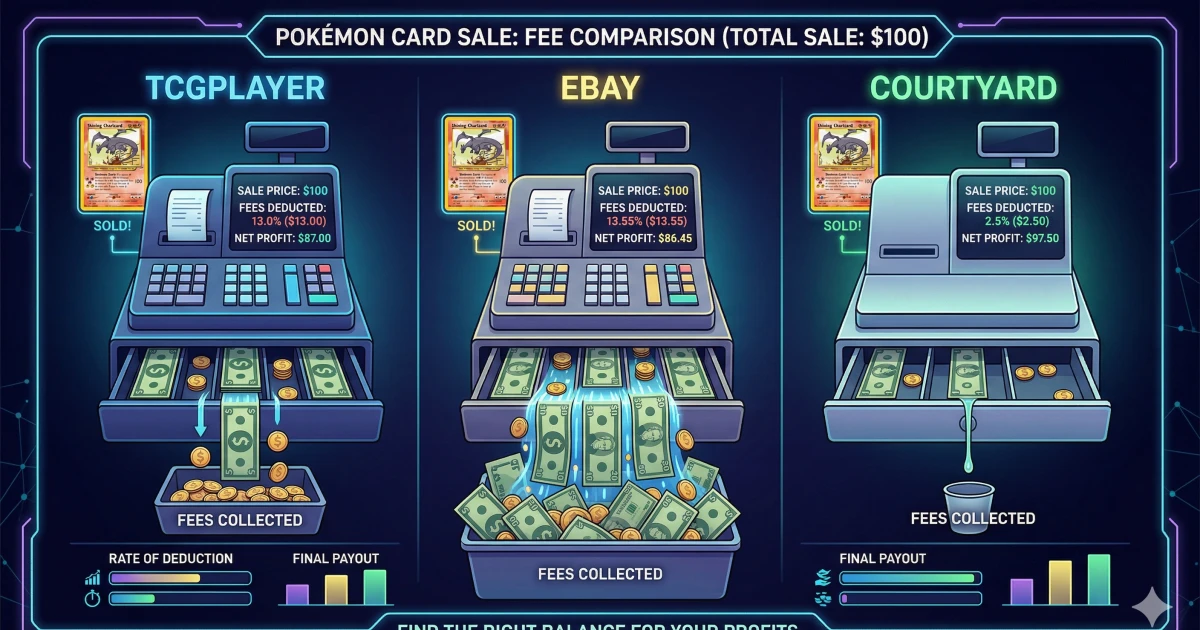
You sell a Darkrai ex for $31 on TCGPlayer. The logic is sound: TCGPlayer's total fee runs 12.75% (10.25% seller fee + 2.5% payment processing), lower than eBay's 13.25%. You net $27.05 and move on.
Then you check eBay's sold history on the same card (daa set). It moved four times in the past week: $40, $43, $45, $41. At the median $43 — after 13.25% fees and $3.50 bubble mailer shipping — net payout is $43 × 0.8675 − $3.50 = $33.80.
You left $6.75 per card on the table not by getting cheated, but by optimizing for the wrong number. Fee percentage doesn't determine your payout. Sale price does. The difference between those two things is where most sellers lose money.
Why the Lowest Fee Platform Often Pays the Least
TCGPlayer is 12.75%. eBay is 13.25%. Half a point. On a $100 card, that's 50 cents. That's the gap traders are routing around when they default to TCGPlayer.
But fees are applied to the sale price. The actual formula is:
Net payout = (sale price × (1 − total fee%)) − shipping
If eBay commands 20–30% higher prices on the same card — and on desirable singles, it consistently does — the fee math inverts. A higher rate on a higher number beats a lower rate on a lower number. The real question isn't which platform charges less. It's which platform pays more after fees and shipping.
The Exact Fee Breakdown, Platform by Platform
| Platform | Seller Fee | Payment Processing | Shipping | All-In Rate |
|---|---|---|---|---|
| TCGPlayer | 10.25% | 2.5% | Buyer pays ($0.99–$3.99) | 12.75% of sale |
| eBay | 13.25% (incl. payment) | Included | Seller pays ($1.50–$5.00) | 13.25% + shipping |
| Courtyard | 0% (vault trades) | 0% | $20–$30 redemption fee | See note |
Courtyard needs separate treatment. The 0% applies only to vault-to-vault trades — buyer and seller exchange digital ownership, no card moves physically. If either party wants the actual card, there's a $20–$30 redemption fee regardless of card value. On a $40 card, that fee is the entire margin. On a $400 PSA 10, it barely registers. Courtyard's fee model works exactly as designed — it just only makes sense for high-value graded cards.
The other issue for raw cards under $100: Courtyard's buyer pool is thinner, and thinner markets command lower prices. Listing a raw $50 card there might mean waiting two weeks for a $38 sale, netting $38 with no fee — while eBay would have moved it at $54 in three days with $47 net after fees and shipping. The 0% fee is real. The economic outcome of choosing Courtyard for mid-range raw cards often isn't.
The Breakeven Table: The Calculation Nobody Runs
Here's what's missing from every fee comparison: at each price point, how much higher does eBay's sold price need to be before eBay nets more than TCGPlayer? The math is straightforward but the result is counterintuitive.
| Card Value (TCGPlayer price) | TCGPlayer Net | eBay Net (same price) | eBay Premium Needed to Win |
|---|---|---|---|
| $10 | $8.73 | $7.18 (w/ $1.50 ship) | +18% |
| $25 | $21.81 | $19.69 (w/ $2.00 ship) | +10% |
| $50 | $43.63 | $39.88 (w/ $3.50 ship) | +9% |
| $100 | $87.25 | $82.75 (w/ $4.00 ship) | +5% |
| $200 | $174.50 | $168.50 (w/ $5.00 ship) | +4% |
The right column is the insight. On a $10 card, eBay needs to fetch 18% more than TCGPlayer's going rate before you come out ahead — that premium rarely materializes on common singles with deep TCGPlayer inventory. On a $200 card, eBay needs just a 4% premium, and eBay consistently commands that gap on desirable singles because its collector and investor buyer base doesn't price-match TCGPlayer the way volume sellers do.
The breakeven threshold shrinks as card value rises. That's the underlying reason platform strategy has to change at different price tiers — not because of arbitrary rules, but because the math shifts.
Who Wins at Each Price Tier: A Clear Verdict
$5–$15: TCGPlayer (with one exception)
Common singles with deep NM inventory hit TCGPlayer's price floor fast. You'll sell at market rate, shipping is on the buyer, and the 18% eBay premium needed to break even almost never appears. The exception: low-price cards with collector demand and thin supply. Before assuming TCGPlayer, pull 30 days of eBay sold data — takes 60 seconds. If eBay sold history shows consistent $13–$15 on a card with a $9 TCGPlayer market price, run the math before defaulting.
$15–$50: Check Both Before You List
This tier genuinely varies by card. A $30 card with 15 competing NM listings on TCGPlayer is price-capped at market. That same card's eBay sold history might show $38–$44 over the past two weeks — at $40, after fees and $2.50 shipping, you net $32.20 vs. $26.18 on TCGPlayer. Two minutes of research, $6 difference. But a $30 card with 2 TCGPlayer listings and rising demand can move within 24 hours at full market price. You need both sold histories before committing to either platform.
$50–$200: eBay Wins Most of the Time
At $50+, the 5–9% eBay premium threshold is consistently cleared by desirable singles. eBay's buyer pool skews toward collectors and investors who trust eBay's buyer protection for higher-value purchases and don't want to create a TCGPlayer account for one card. Your net is typically $5–$20 more per sale at this tier on eBay. The exception: bulk pulls from a newly released set where eBay inventory is just as flooded as TCGPlayer and neither platform commands a meaningful premium.
$200+ Graded: Courtyard Is Worth Running the Numbers
A PSA 10 at $400 on eBay costs $53 in fees plus $6 tracked shipping — you net $341. Vault-traded on Courtyard at 0%: $400 net, assuming both parties are comfortable with vault ownership. That $59 difference is real money. Courtyard's buyer pool for $200+ graded cards is active and serious. Below $200, or for raw cards at any price, the redemption fee and thin market make the math work against you.
When Platform Price Gaps Dwarf Fee Differences Entirely
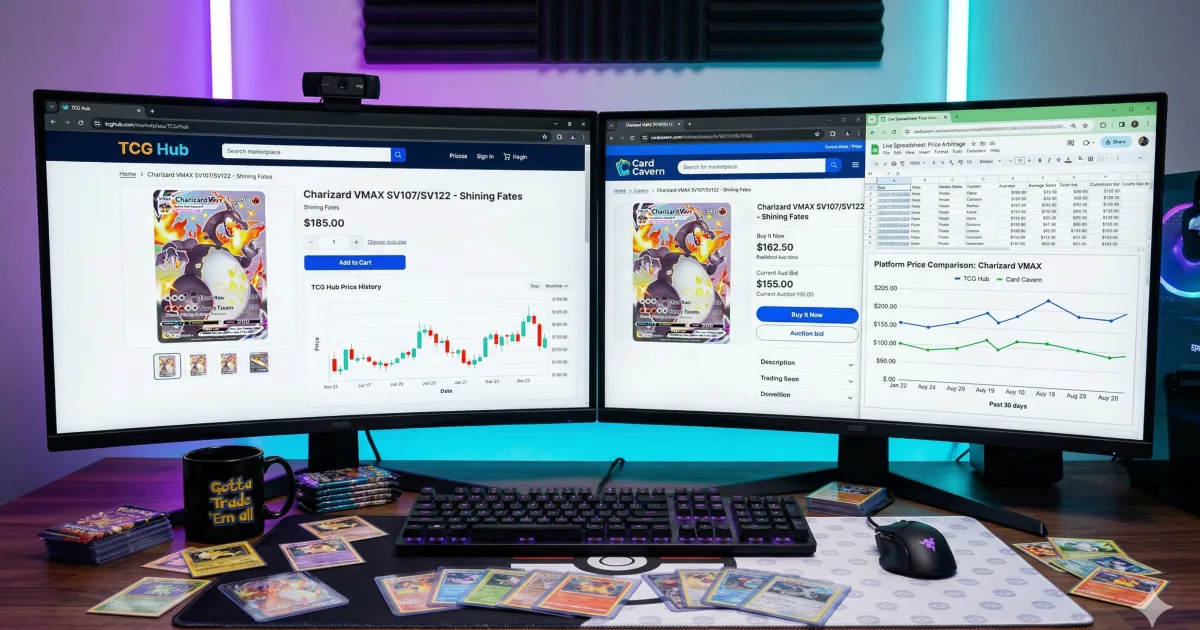
GapSense's live market scanner currently shows 295 active arbitrage opportunities across platforms — situations where the platform price gap is the dominant factor, not fee percentages. Darkrai (daa set) is showing up repeatedly in this data: eBay demand is significantly outpacing what other platforms have priced this card at. The price delta between platforms makes the 0.5% fee difference between TCGPlayer and eBay essentially irrelevant — you're leaving real money behind by picking the wrong market, regardless of fee rate.
Pikachu (Mew set) has shown +115% price momentum recently with eBay capturing most of that movement. Sellers who listed on TCGPlayer to save on fees during that momentum window missed the bulk of the gain. When a card is trending, eBay's collector-heavy buyer base reprices faster and higher than TCGPlayer's volume market. Platform selection during momentum events is worth more than any fee optimization.
This is the pattern: when a card is trending, eBay leads on price and TCGPlayer lags. When a card is stable and common, TCGPlayer's structure wins. Knowing which state your card is in determines more than any fee calculation.
🔍 Find Live Pokemon Card Price Gaps Automatically → GapSense.uk
The 2-Minute Platform Decision
Before listing any card, run through this in order:
- Pull eBay sold listings (last 30 days, NM condition). Record the median sold price — sold listings, not active. Active listings show asking prices; sold listings show what buyers actually paid.
- Pull TCGPlayer recent sales for the same condition and note the current market price.
- Apply the breakeven check: Is eBay's median sold price more than 18% above TCGPlayer ($5–$15 cards), 10% above ($15–$50), or 5% above ($50–$200)?
- Yes → eBay. At parity or TCGPlayer higher → TCGPlayer. Graded card above $200 → also check Courtyard sold comps.
Two minutes per card. The check is always the same. For broader context on how each platform's buyer base differs structurally — which affects where price premiums appear — the full platform comparison covers the demand-side mechanics behind these price gaps.
One More Cost to Factor: eBay Promoted Listings
eBay's optional promoted listings (2–12% additional fee, charged only on promoted sales) shift the breakeven math if you use them. At 5% promoted rate, your total eBay cost becomes 18.25% plus shipping. At that rate, the eBay breakeven threshold on a $50 card jumps to roughly +18% — same threshold as a $10 card without promotion. For most cards, skip it and list organically. For meta-relevant cards in a 48-hour demand window, 5% promoted to capture buyers before the hype fades can be worth the math. Calculate before activating, not after.
The Verdict
Lowest fee does not mean highest payout. By price tier:
- Under $15: TCGPlayer — fee structure and buyer-paid shipping make it the better net return on common singles
- $15–$50: Check both sold histories, takes 2 minutes — the right answer genuinely varies by card
- $50–$200: eBay — consistently commands the 5–9% premium that clears the fee gap
- $200+ graded: Run Courtyard numbers — vault-to-vault at 0% is real savings at this tier
The one habit worth building: check eBay sold comps before listing anywhere. Fee percentages are static. Platform price gaps shift constantly — and that's where the actual money is. For traders moving more than 10 cards a week, automating that cross-platform comparison removes the manual check entirely.
🔍 Find Live Pokemon Card Price Gaps Automatically → GapSense.uk
Platform Comparison · Fees · TCGPlayer · eBay · Courtyard · Selling Strategy
Related Articles
Find Live Pokemon Card Price Gaps Automatically
Try GapSense.uk