Courtyard vs TCGPlayer: 5 Hidden Price Gaps Traders Miss in 2026
Compare Courtyard vs TCGPlayer fees, prices, and hidden gaps. Learn where Pokemon card prices differ most and how traders profit from cross-platform arbitrage.
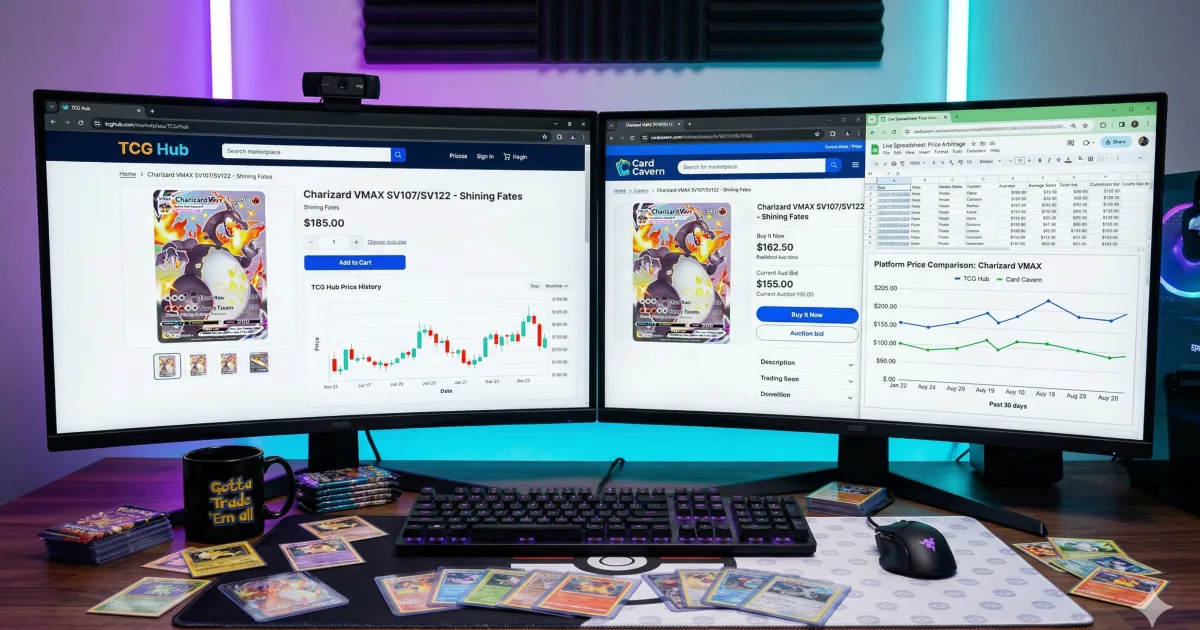
The same Charizard ex sits at $14.50 on Courtyard and $22.80 on TCGPlayer right now. That's a $8.30 gap on a single card — and it's not an outlier. Courtyard.io, the fractional and full-card marketplace built around vaulted collectibles, prices Pokemon cards differently than TCGPlayer because the buyer pools, fee structures, and listing dynamics are fundamentally different. If you're only checking one platform, you're leaving money on the table every single week.
I've been trading across both platforms for over two years, moving 200+ cards per month between Courtyard, TCGPlayer, and eBay. The price differences aren't random — they follow patterns. Once you see the patterns, you can source cards on the cheaper platform and sell where demand (and prices) run higher. Here's exactly how the two platforms compare, where the gaps are widest, and how to exploit them before they close.
- Courtyard typically prices vaulted/graded cards 10–25% below TCGPlayer market value due to smaller buyer pool and fractional ownership dynamics
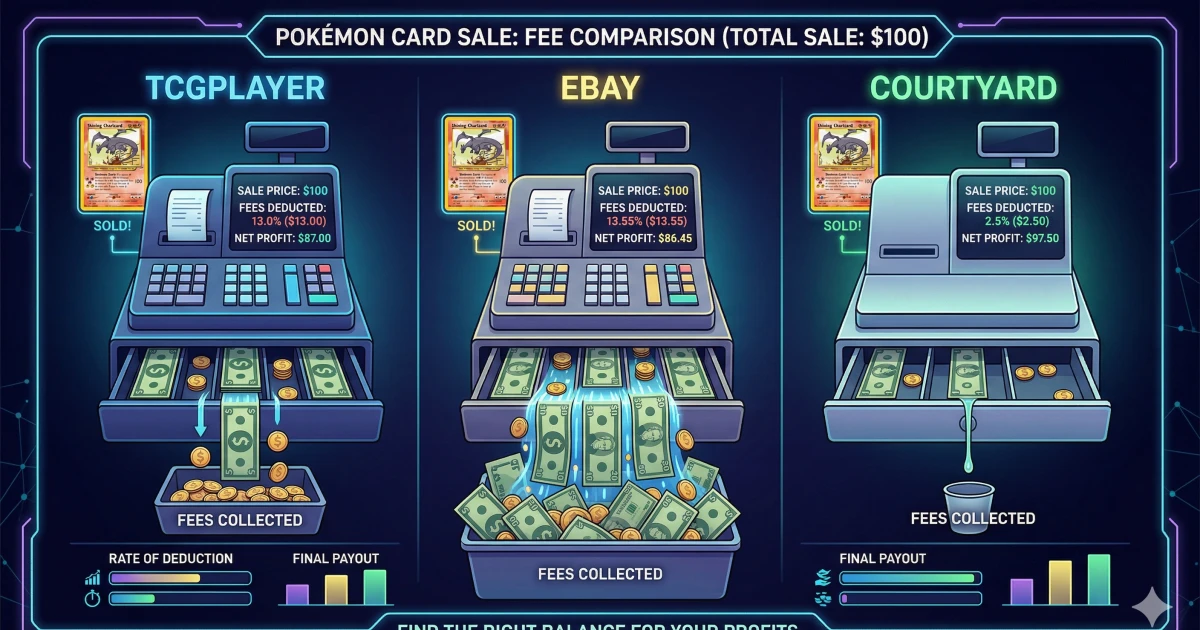
- TCGPlayer seller fees run ~12.55% vs Courtyard's ~10% transaction fee — but Courtyard charges vault storage fees that eat margins on low-value holds
- The biggest gaps appear on mid-tier graded cards ($15–$60 range) and newly vaulted cards in the first 2–3 weeks
- Arbitrage works best when you buy full cards on Courtyard and relist on TCGPlayer or eBay — not the other way around
- Use automated price comparison tools like GapSense.uk to find these gaps in real time
Table of Contents
- What Is Courtyard and How Does It Compare to TCGPlayer?
- How Do Fees Compare Between Courtyard and TCGPlayer?
- Where Do the Biggest Price Gaps Appear?
- Why Do These Price Differences Exist?
- How to Profit from Courtyard vs TCGPlayer Price Gaps
- What Are the Risks of Cross-Platform Arbitrage?
- Which Platform Should You Use for Buying vs Selling?
- Frequently Asked Questions
🔍 Find Live Pokemon Card Price Gaps Automatically → GapSense.uk
What Is Courtyard and How Does It Compare to TCGPlayer?
TCGPlayer needs no introduction — it's the dominant marketplace for Pokemon singles with thousands of sellers, verified listings, and a buyer protection guarantee. It's where most traders check prices first. Courtyard.io is the newer player that does things differently.
Courtyard lets you buy, sell, and trade physical collectibles that are stored in insured, professional vaults. You buy a card on Courtyard, it stays in their vault. You can sell it to another user, redeem it for physical delivery, or in some cases buy fractional shares of high-value cards. The card never moves until you want it to.
This vaulting model changes the pricing dynamics entirely. On TCGPlayer, sellers set prices based on visible competition from dozens of other sellers listing the same card. On Courtyard, the supply is limited to what's been vaulted, the buyer pool is smaller, and pricing reflects a different set of market forces.
That difference in how prices get set is exactly where the opportunity lives.
How Do Fees Compare Between Courtyard and TCGPlayer?
Fees determine whether a price gap is actually profitable or just an illusion. Here's the real breakdown:
| Fee Type | Courtyard | TCGPlayer |
|---|---|---|
| Seller Transaction Fee | ~10% | ~12.55% (Level 1 seller) |
| Buyer Premium | None | None (included in listed price) |
| Payment Processing | Included in transaction fee | Included in seller fee |
| Shipping (Seller) | $0 (vaulted, no shipping between trades) | $0.78–$4.50+ depending on method |
| Vault Storage | Free for short holds; fees may apply for long-term storage | N/A |
| Redemption (Physical Delivery) | ~$5–$15 depending on location | N/A |
The key insight: Courtyard's lower transaction fee and zero shipping cost between trades means your effective cost per flip is lower — if you're buying and selling within Courtyard. But if you're buying on Courtyard and relisting on TCGPlayer or eBay, you need to factor in the redemption fee to get the physical card in hand.
For a $30 card, the math looks like this: Buy on Courtyard at $24.00, redeem for ~$8 shipping/handling, relist on TCGPlayer at $32.00. After TCGPlayer's 12.55% fee ($4.02) and $1.20 PWE shipping: net profit = $32.00 - $24.00 - $8.00 - $4.02 - $1.20 = -$5.22 loss. The redemption cost kills the margin on lower-value cards.
That's why the profitable arbitrage direction matters — and why you need to know which price ranges actually work.
Where Do the Biggest Price Gaps Appear?
After tracking hundreds of cross-platform price comparisons, the gaps consistently cluster in specific categories:
1. Mid-tier graded cards ($40–$150 range). A PSA 9 Umbreon VMAX Alternate Art might list at $85 on Courtyard while the same card in the same grade sells for $105–$115 on TCGPlayer. At this price point, the redemption fee ($8–$12) still leaves a profitable spread. Typical gap: 15–25%.
2. Newly vaulted cards in weeks 1–3. When Courtyard adds new inventory to their vault — especially from recent set releases — sellers often price aggressively to move cards quickly on a platform with fewer eyeballs. Scarlet & Violet era cards regularly show 10–20% discounts vs TCGPlayer during the first few weeks after vaulting.
3. Vintage cards with established TCGPlayer premiums. Base Set holos, Neo Genesis rares, and other vintage staples carry nostalgia premiums on TCGPlayer that Courtyard's younger, more investment-focused user base doesn't always match. A Base Set Blastoise (LP-NM, ungraded equivalent) might sit at $42 on Courtyard while TCGPlayer NM copies move at $55+.
4. Japanese cards. TCGPlayer has deeper liquidity for Japanese Pokemon cards. Courtyard's selection is growing but thinner, which means Japanese card sellers on Courtyard sometimes undercut significantly to find buyers.
The gap is smallest on ultra-high-value cards ($500+) where both platforms attract serious buyers who do their homework, and on bulk/low-value cards where the redemption fee makes arbitrage impossible.
Why Do These Price Differences Exist?
Price gaps between Courtyard and TCGPlayer aren't a glitch — they're structural. Understanding why they exist helps you predict where new gaps will open.
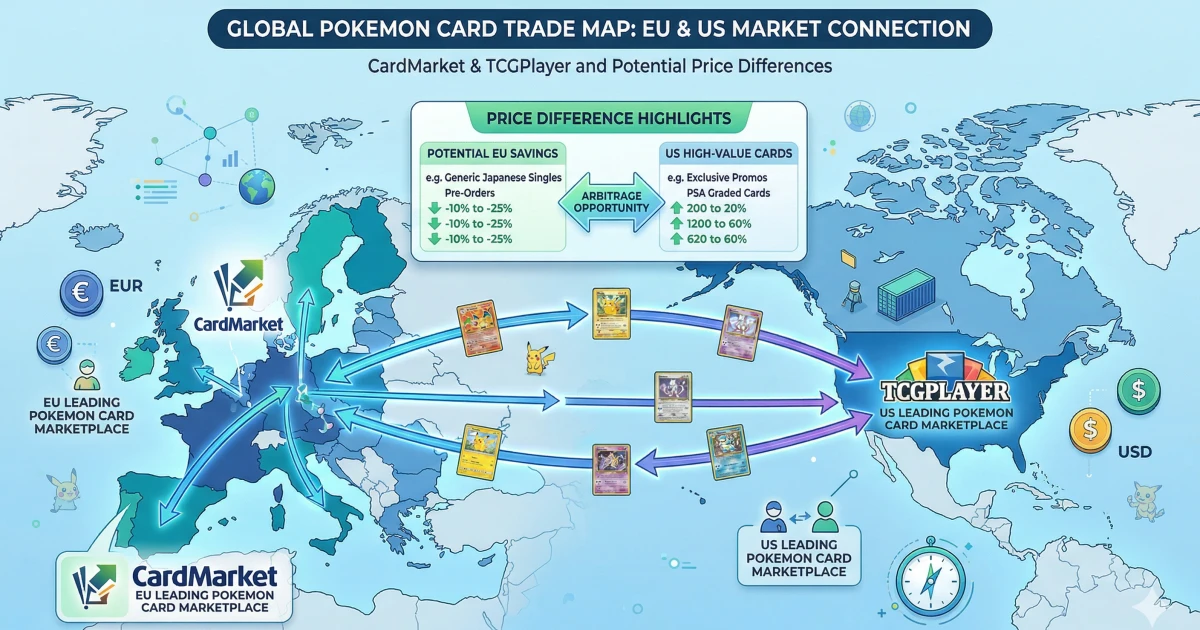
Different buyer pools. TCGPlayer attracts players, collectors, and traders. Courtyard skews toward investors and collectors who treat cards as alternative assets. When a card's play value drops (rotation, meta shifts), TCGPlayer prices react faster because players dump. Courtyard prices lag because investors care less about playability.
Supply visibility. On TCGPlayer, you see 47 sellers listing the same card and the price race to the bottom is immediate and visible. On Courtyard, vaulted supply is whatever has been deposited — often just a handful of copies. Less competition means less price pressure, but it also means prices can sit stale, both above and below true market value.
Liquidity friction. Selling on Courtyard means your buyer is another Courtyard user. Selling on TCGPlayer means your buyer is anyone searching Google for that card. Higher liquidity on TCGPlayer supports higher prices because sellers know the card will move. On Courtyard, sellers sometimes price lower to compensate for slower turnover.
The vaulting delay. Getting a card into Courtyard's vault takes time — shipping, authentication, listing. This delay creates temporary disconnects from the live market. A card that spiked on TCGPlayer yesterday won't reflect that spike on Courtyard for days or weeks.
These structural differences aren't going away. As long as the platforms serve different audiences with different mechanics, price gaps will keep appearing.
How to Profit from Courtyard vs TCGPlayer Price Gaps
Here's the step-by-step system I use to find and execute cross-platform trades:
Step 1: Identify candidates. Focus on graded cards in the $40–$150 range on Courtyard. Filter for PSA 8–10 and CGC equivalents. These have the best gap-to-redemption-cost ratio. Cards under $40 rarely survive the redemption fee math.
Step 2: Cross-reference on TCGPlayer. For every Courtyard card that catches your eye, check TCGPlayer's market price — not the lowest listing, but the recent sales tab. You want to know what the card actually sells for, not what optimistic sellers are asking. The gap needs to be at least 20% to cover all fees and still leave margin.
Step 3: Check eBay sold listings. eBay often has the highest realized prices for graded Pokemon cards because of the massive buyer pool. Search the exact card + grade in eBay's "Sold Items" filter for the last 30 days. If eBay sold prices confirm TCGPlayer's range (or exceed it), you have a high-confidence trade.
Step 4: Calculate real profit. Use this formula for Courtyard → TCGPlayer arbitrage:
Net Profit = TCGPlayer sale price - (TCGPlayer seller fee × sale price) - Courtyard purchase price - Redemption fee - Shipping cost
Example: Courtyard buy at $65, TCGPlayer sell at $92.
$92 - ($92 × 0.1255) - $65 - $10 redemption - $4.50 tracked shipping = $92 - $11.55 - $65 - $10 - $4.50 = $0.95 profit.
That's barely worth the effort. But the same card selling at $98 on eBay?
$98 - ($98 × 0.129) - $65 - $10 - $4.50 = $98 - $12.64 - $65 - $10 - $4.50 = $5.86 profit.
The platform you sell on changes everything. Run the numbers before you buy.
Step 5: Automate the scanning. Manually checking prices across Courtyard, TCGPlayer, and eBay for hundreds of cards is brutal. This is where tools like GapSense.uk save hours — they surface cross-platform price gaps automatically so you spend time trading, not searching.
That's the execution. But every system has failure modes — and ignoring them is how traders lose money fast.
What Are the Risks of Cross-Platform Arbitrage?
Redemption time kills fast-moving gaps. Getting a card out of Courtyard's vault and into your hands takes days to weeks. If the TCGPlayer price drops during that window, your profitable trade becomes a losing one. This is the #1 risk. Mitigate it by focusing on cards with stable price histories, not cards riding a temporary spike.
Condition mismatches. Courtyard vault cards are authenticated, but when you relist on TCGPlayer, buyers have specific condition expectations. A card that Courtyard lists as "Near Mint" might get a TCGPlayer buyer disputing the condition. Graded cards eliminate this risk entirely — PSA 9 is PSA 9 regardless of platform.
Fee changes. Both platforms adjust their fee structures periodically. TCGPlayer has raised seller fees multiple times. Courtyard's redemption fees have also shifted. A strategy that nets $6 per card today might net $2 after a fee increase. Track fee announcements from both platforms.
Market saturation. If enough traders discover the same gap, prices converge. The best gaps are the ones you find early. By the time a YouTube video features a specific card's cross-platform arbitrage opportunity, it's usually closing or closed.
Capital lock-up. Money spent on Courtyard is locked until you sell or redeem. If you buy 10 cards at $60 each, that's $600 tied up. If the trades take 2–3 weeks to complete round-trip, your capital velocity is low. Start small, prove the system works, then scale.
Which Platform Should You Use for Buying vs Selling?
Based on two years of cross-platform trading, here's the simple framework:
Buy on Courtyard when:
- The card is graded and priced 20%+ below TCGPlayer market price
- You plan to hold (vault storage eliminates shipping/handling risk)
- You want exposure to a card's price movement without dealing with physical storage
- You're building a long-term investment portfolio of Pokemon cards
Buy on TCGPlayer when:
- You need the physical card in hand quickly (for play, for grading submission, for immediate resale)
- You want the widest selection and most competitive pricing from multiple sellers
- The card is raw (ungraded) — TCGPlayer's condition guarantees and buyer protection are stronger for raw cards
- You're buying cards under $30 where Courtyard's redemption fee destroys the value proposition
Sell on TCGPlayer or eBay when:
- You have the physical card and the TCGPlayer/eBay price is 15%+ above what Courtyard users are paying
- The card has high liquidity (popular Pokemon, competitive staples, chase cards from recent sets)
- You want the fastest sale — TCGPlayer's buyer traffic is significantly higher
Sell on Courtyard when:
- The card is already in their vault (no shipping cost, no handling, instant listing)
- You bought on Courtyard and the price has risen — flipping within Courtyard has the lowest fee overhead
- The card appeals to investors more than players (vintage holos, high-grade modern chase cards)
The bottom line: the platform you choose should be determined by the specific card, your timeline, and the current price gap — not brand loyalty. Check both every time.
Frequently Asked Questions
Is Courtyard legit for buying Pokemon cards?
Yes. Courtyard stores cards in insured, professionally managed vaults and authenticates cards before listing. The platform has processed millions in transactions. The main difference from TCGPlayer is the vaulting model — you don't hold the physical card unless you redeem it, which adds a fee. For graded cards and long-term holds, this is actually an advantage since the vault eliminates storage and damage risk on your end.
How long does it take to redeem a card from Courtyard?
Redemption typically takes 5–15 business days depending on your location and shipping method. This processing time is the main drawback for arbitrage traders — if market prices shift during that window, your expected profit margin can shrink or disappear. Factor this delay into every cross-platform trade you plan.
Can you make consistent money trading between Courtyard and TCGPlayer?
Consistent small profits are realistic if you focus on the right price range ($40–$150 graded cards), verify gaps using sold data (not active listings), and account for all fees including redemption and shipping. Traders who treat this systematically — scanning daily, running the numbers before every buy — typically see $3–$12 net profit per successful flip. The key word is consistent: one big score is less valuable than a repeatable system.
What types of Pokemon cards have the biggest price gaps between platforms?
Mid-tier graded cards (PSA 8–10 in the $40–$150 range) consistently show the largest gaps. Newly vaulted cards in weeks 1–3 after Courtyard adds them also show significant discounts. Vintage holos (Base Set, Jungle, Fossil) with established TCGPlayer premiums are another reliable category. Ultra-high-value cards ($500+) tend to have smaller gaps because serious buyers actively check multiple platforms.
Do I need a TCGPlayer seller account to do cross-platform arbitrage?
Yes, you'll need a TCGPlayer seller account (free to set up, but requires verification) if you plan to relist cards there. Alternatively, you can sell on eBay, which sometimes yields higher realized prices for graded cards due to auction dynamics and a larger international buyer pool. Many arbitrage traders maintain active seller accounts on both TCGPlayer and eBay and list on whichever platform shows higher recent sold prices for that specific card.
🔍 Find Live Pokemon Card Price Gaps Automatically → GapSense.uk
Keywords: Platform Comparison, Pokemon TCG Trading, Courtyard, TCGPlayer, Card Arbitrage, lang:en
Related Articles
Find Live Pokemon Card Price Gaps Automatically
Try GapSense.uk