The CardMarket→TCGPlayer Arbitrage Most US Traders Miss
Vintage Pokemon cards on CardMarket often price 30–60% below TCGPlayer. Full fee math, real shipping costs, and three live arbitrage card examples.
🔍 Find Live Pokemon Card Price Gaps Automatically → GapSense.uk
The same Resistance Gym card from Gym Heroes lists at €9–12 on CardMarket from European sellers. On TCGPlayer, the NM median has moved to $22–26 following a 54.8% surge in vintage Gym series demand. That spread isn't a one-off — the structural reasons behind it apply to dozens of vintage cards right now, and most US traders aren't sourcing from CardMarket at all.
Below is the complete math — including honest international shipping costs, since those are exactly where most arbitrage guides quietly inflate the numbers and make the margins look better than they are.
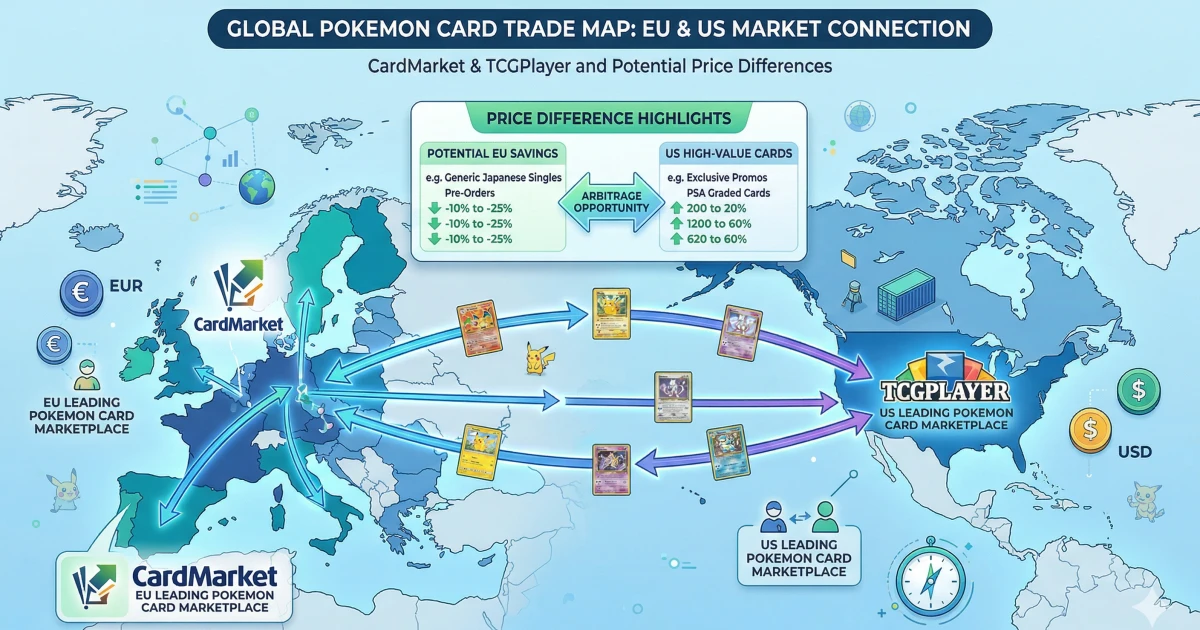
Why CardMarket Lists the Same Cards Cheaper Than TCGPlayer
Three factors create and sustain the gap. They reinforce each other.
Fee Structure Asymmetry: 7–8% Head Start Before Geography
CardMarket sellers pay a 5% commission — capped at €5 for any transaction over €100. TCGPlayer sellers pay 10.25% plus payment processing: roughly 12.5–12.75% all-in. That 7–8% gap means a EU seller can price a card at $15 where a TCGPlayer seller needs to list the same card at $17 to net the same margin. As the buyer, you're starting 7–8% ahead before any geographic price difference even comes into play.
The Price Guide Problem: Why CardMarket Systematically Undervalues US Demand
This is the insight most platform comparison guides miss entirely. CardMarket uses an automated price guide calibrated to European sales history. For cards that trade rarely in Europe but frequently in the US — Neo-era sets, vintage Gym series, Base/Fossil era classics — the CardMarket price guidance is built on stale EU data. EU sellers anchor their listings to that guidance, because that's the only market data visible to them.
Meanwhile, TCGPlayer's higher US trading volume means prices update within days of any demand shift. The result: cards with strong US nostalgia demand but low EU collector interest develop a persistent price floor disconnect between the two platforms. It's not random variance. It's a structural lag that affects the same category of cards consistently — and it's why searching CardMarket for Gym Heroes or Neo Discovery cards consistently surfaces prices that look wrong to any US trader who checks TCGPlayer immediately after.
Currency Rate as a Margin Multiplier
With EUR/USD hovering around 1.07–1.09 in April 2026, a €10 CardMarket card costs $10.80 in USD terms. When the dollar strengthens — moving from 1.10 to 1.05 — the same €10 card becomes $10.50 while TCGPlayer prices stay fixed. Across a 10-card batch, that's a $5 improvement in cost basis with no change in sell-side pricing. It's a secondary factor, not the primary thesis, but worth timing: dollar-strong periods improve the CardMarket import math by 3–5%, and that compounds meaningfully on regular buying programs.
Three Cards With Open Margins Right Now (April 2026)
These are based on current price momentum data and the structural gap described above. Before executing, run the TCGPlayer 30-day sold average and current CardMarket listings yourself — momentum cards reprice weekly.
Resistance Gym (Gym Heroes)
Gym series trainer cards are showing a 54.8% price increase in recent US sold data. EU sellers haven't repriced — Gym series cards aren't competitively relevant in European formats, so CardMarket listings reflect modest local collector demand, not the US nostalgia premium driving the current surge.
Margin math — 5-card batch, NM raw:
- CardMarket average: €9.00/card → €45.00 total
- At EUR/USD 1.08: $48.60
- Tracked EU-to-US shipping (Deutsche Post/PostNL, bubble mailer ~180g): €14.00 → $15.12
- Total landed cost: $63.72 — $12.74 per card
- TCGPlayer 30-day sold median (NM, post-surge): ~$22.00
- TCGPlayer seller fee (12.75%): −$2.81
- Shipping to buyer (PWE): −$0.80
- Net per card: $18.39 | Profit per card: $5.65
- Total on 5 cards: $28.25 | ROI on landed cost: ~44%
Sneasel (Neo Discovery)
Neo Discovery Sneasel is showing +105.5% in recent US price movement. Neo-era cards defined the late-1990s US competitive meta — the nostalgia premium is almost entirely a North American phenomenon. European collectors don't attach the same historical weight, which keeps CardMarket listings anchored to modest EU demand while US prices surge.
This card also demonstrates exactly why single-card imports rarely work at mid-value price points:
Solo import:
- CardMarket: €7.50 → $8.10
- Tracked EU-to-US (padded envelope, single card): €12.50 → $13.50
- Landed cost: $21.60
- TCGPlayer sold median (NM): ~$28.00
- After fees ($3.57) and shipping to buyer ($0.80): net $23.63
- Profit: $2.03 — not worth the effort
Added to a 6-card Gym/Neo batch:
- Batch shipping allocation: €14.50 ÷ 6 = €2.42/card → $2.61/card
- Landed cost: $8.10 + $2.61 = $10.71
- Net after fees: $23.63 (same sell price)
- Profit: $12.92 per card — 121% ROI on cost basis
Same card. The entire difference is how shipping overhead gets allocated. Batching isn't a nice-to-have for this strategy — it's the mechanism that makes mid-value cards viable.
Pikachu — Scarlet & Violet 151 (SV3.5)
The 151 set Pikachu variants (Illustration Rare and Full Art) are showing +115% momentum. The 151 set is the "Gen 1 nostalgia" release for modern collectors — US demand is intense and concentrated. Europe has strong supply of Japanese imports with pricing that reflects local EU collector demand, not the US premium.
Margin math — 3-card batch, NM Illustration Rare:
- CardMarket average: €14.00/card → €42.00
- At EUR/USD 1.08: $45.36
- Tracked EU-to-US shipping (padded mailer, 3 cards ~80g): €13.00 → $14.04
- Total landed: $59.40 — $19.80 per card
- TCGPlayer sold median: ~$42.00
- After fees ($5.36) and shipping ($0.80): net $35.84
- Profit per card: $16.04 | Total on 3 cards: $48.12 | ROI: 81%
Higher-value cards absorb shipping overhead far more efficiently. At €14 purchase price, the €13 tracked shipping is 22% of total landed cost. At €7.50 purchase price on a solo import, the same €12.50 shipping is 58% of cost. The first filter for any CardMarket sourcing decision: will this card's sell price absorb what it costs to move it across the Atlantic?
The Friction That Actually Kills This Strategy
Shipping Costs Are Higher Than Most Examples Show
Tracked shipping from Germany, Netherlands, or France to the US via Deutsche Post or PostNL realistically costs €11–15 for a standard bubble mailer containing 5–8 raw cards. Untracked options run €2–5 but create real loss exposure on anything worth more than €15 — a single lost shipment wipes multiple successful trades. Express carriers (DHL, FedEx) add €25–40 and only make financial sense for insured high-value graded card shipments.
The minimum threshold for a solo card import to work: roughly €20+ CardMarket purchase price with a TCGPlayer NM median above $45. Below that, batch buying is the only path to a real margin. For a deeper look at how shipping decisions affect overall profit on card trades, the Pokemon card shipping guide covers packaging and carrier choices that apply across domestic and international sends.
Not All CardMarket Sellers Ship to the US
Many EU sellers restrict shipping to Europe only. Filter for "Worldwide" shipping in CardMarket's search, or check each seller profile directly. German and Dutch professional sellers with 1,000+ transactions are the most reliable for international shipments — they know the customs process and pack correctly. Expect a 5–15% price premium on the subset of sellers who ship globally. That narrower pool is where you want to build a buying relationship.
Condition Grade Mapping
CardMarket's "Near Mint" is not TCGPlayer's NM. CardMarket grades by individual seller judgment with no standardized inspection. Vintage cards — Gym series, Neo-era, Base/Fossil — frequently arrive as TCGPlayer Lightly Played when described as CardMarket NM. Build a 5–10% condition haircut into your sell-price projections for pre-2003 cards, or list conservatively and let actual condition drive final pricing.
Customs and Duties
US Customs allows imports under $800 in declared value duty-free from the EU under the de minimis threshold. Individual card batches rarely approach this. One exception worth noting: if you're routing through a UK reshipping service, imports to the UK over £135 may incur VAT — factor this into your landed cost if using that route.
How to Verify a Gap Before You Buy (5-Minute Check)
Before committing to any CardMarket batch, run this in order:
- TCGPlayer → "Recently Sold" tab. Not the active listings — active listings reflect seller optimism, not what buyers actually paid. Use the 30-day NM average as your sell price.
- CardMarket → filter Near Mint or Mint, Worldwide shipping, sort by lowest price. Check how many sellers have NM copies. Four or more means you can batch-buy without clearing available supply and leaving yourself with nothing for future orders.
- Run the formula: (TCGPlayer 30-day NM avg × 0.8725 − $0.80) − (CardMarket price × EUR/USD rate) − (tracked EU shipping in USD ÷ batch size). Target: $4+ net profit per card minimum before executing.
For momentum cards — where TCGPlayer prices are rising week-over-week — this check is time-sensitive. EU sellers monitoring CardMarket's own sold history typically reprice 3–6 weeks after a US price surge becomes visible in their own sales data. The deeper the US price has already moved, the more likely some EU sellers have noticed and updated. Prioritize sellers with lower feedback counts: smaller hobby sellers check market comps less frequently and are more likely to still be listing at pre-surge prices.
For cross-referencing which cards have the deepest current momentum, GapSense tracked 164 active price momentum signals and 106 same-platform flip opportunities as of April 5, 2026. Once cards are in hand and ready to list, the TCGPlayer vs eBay vs Courtyard comparison covers which platform maximises net proceeds by card type.
Margin Calculator: Know the Numbers Before You Buy
| CardMarket Buy | TCGPlayer Sell | Batch Size | Shipping/Card (USD) | Net Profit/Card |
|---|---|---|---|---|
| €5 ($5.40) | $14 | Solo | $13.50 | −$7.49 ❌ |
| €5 ($5.40) | $14 | 6-card batch | $2.61 | +$3.41 ✓ |
| €9 ($9.72) | $22 | 5-card batch | $3.02 | +$5.65 ✓ |
| €14 ($15.12) | $42 | 3-card batch | $4.68 | +$16.04 ✓✓ |
| €25 ($27.00) | $70 | Solo | $13.50 | +$19.78 ✓✓ |
| €45 ($48.60) | $120 | Solo | $13.50 | +$41.80 ✓✓✓ |
EUR/USD 1.08. TCGPlayer seller fee 12.75% applied to sell price. $0.80 shipping to buyer deducted. EU tracked shipping costs: solo card or 3-card padded envelope €12.50–13.00; 5-card bubble mailer €14.00; 6-card bubble mailer €14.50 (Deutsche Post/PostNL international tracked rates, April 2026).
The rule the table makes clear: sub-€10 cards need a 5-card minimum batch. €25+ cards work as solo imports. €40+ cards offer the most asymmetric margin-to-capital ratio — and if you can find three €40 CardMarket cards underpriced against a $100+ TCGPlayer median, a single batch order covers its own shipping cost many times over.
Your First CardMarket→TCGPlayer Trade: Step-by-Step
- Pick one of the three cards above (Resistance Gym, Sneasel, or 151 Pikachu). Start with a set you already know how to grade by eye.
- Go to TCGPlayer and check "Recently Sold" — NM condition, last 30 days. Write down the average. That's your real sell price.
- Go to CardMarket. Filter: Near Mint or Mint, Worldwide shipping, sort lowest price. Note the cheapest 3–5 listings and how many NM copies are available total.
- Run the formula: (TCGPlayer avg × 0.8725 − $0.80) − (CardMarket price × 1.08) − (EU tracking cost in USD ÷ batch size). Result above $4 per card: execute. Below $4: pass or wait for better alignment.
- Order from a single seller if possible — combined shipping typically saves €2–4. Minimum 4–5 cards per order to make the per-card shipping overhead worthwhile.
- When cards arrive, grade against TCGPlayer's NM/LP standard — not CardMarket's. List at the current NM median on TCGPlayer, not the lowest active listing. You're selling into existing buyer demand at an established price, not competing on cheapest available.
- Track actual sell-through time. Neo-era and vintage Gym cards in NM typically move within 7–14 days at median price on TCGPlayer. If a card sits beyond 3 weeks, drop to the lowest NM active listing and recalibrate your buy criteria for that card.
The difference between traders who run this consistently and those who abandon it after a few trades: they run the formula on every card before buying, including the ones that intuitively look like a deal. Intuition gets expensive when shipping costs don't cooperate. The formula doesn't.
🔍 Find Live Pokemon Card Price Gaps Automatically → GapSense.uk
Platform Comparison · CardMarket · TCGPlayer · Arbitrage · Trading Strategy · Price Guide · Pokemon Cards
Related Articles
Find Live Pokemon Card Price Gaps Automatically
Try GapSense.uk