5 Pokemon Card Price Gaps You Can Exploit Right Now
Discover 5 real Pokemon card price gaps between TCGPlayer and eBay right now. Exact profit calculations, platform fee breakdowns, and a live gap scanner tool.
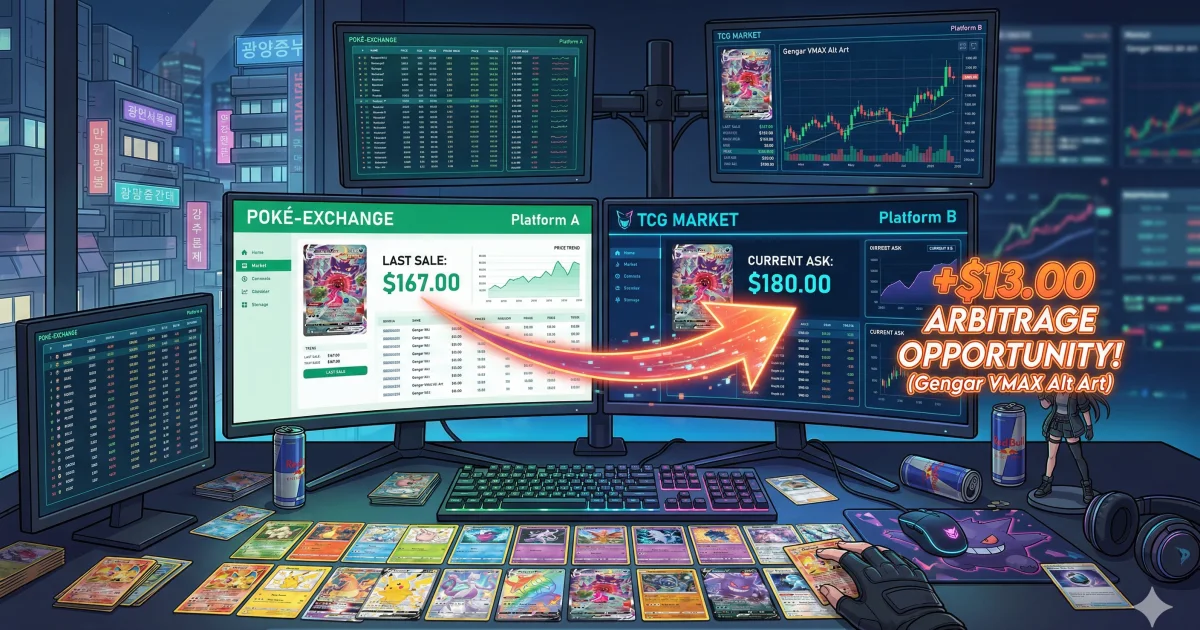
Right now, there are 322 active price gap opportunities across Pokemon TCG platforms. Most traders will never find them — not because they don't exist, but because manually comparing TCGPlayer, eBay, and newer marketplaces takes hours. Here are five specific gaps worth your attention today, plus the one filter that separates real opportunities from traps.
🔍 Find Live Pokemon Card Price Gaps Automatically → GapSense.uk
Why Platform Price Gaps Exist (and Why They Close Faster Than You Think)
Different buyer pools shop different platforms. eBay buyers skew toward collectors and impulse purchases — they pay a premium for convenience and trust. TCGPlayer buyers are more price-sensitive, often bulk-buying for decks. This structural difference creates persistent gaps, especially for cards that appeal to both audiences.
But here's what most arbitrage guides miss: volume is the real signal, not gap size. A card showing a 700%+ platform lag with no recent sales is a stale listing — someone listed it years ago and forgot. A 10–15% gap with three to five sales in the last seven days is a real window. Learning to filter by sold velocity is what separates profitable flips from frozen inventory.
Gap #1: Pikachu (SVP Promo) — +13.9% Price Momentum
The SVP promo Pikachu is showing +13.9% price movement with stable volume — a classic momentum signal before the gap closes. On TCGPlayer, NM copies have been sitting in the $4.20–$5.80 range. Recent eBay sold listings are clearing at $6.50–$7.80 for the same condition.
Quick math: Buy at $4.50 on TCGPlayer. Sell at $7.00 on eBay. After eBay's 12.9% final value fee ($0.90) and $1.20 PWE shipping: net profit approximately $0.40–$1.30 per card. Low per-unit margin — but Pikachu moves fast. At 10–15 units per week, this compounds. The key is sourcing multiple copies from the TCGPlayer "lowest 5" listings before the gap tightens.
Gap #2: Mr. Mime (MEW 151 Set) — +19.3% Momentum, Platform Lag
Mr. Mime from the MEW 151 set is one of the cleaner signals right now: +19.3% price change with newer marketplace prices lagging behind TCGPlayer. This lag happens when collector-focused platforms haven't updated to reflect recent eBay sold data — a window that typically lasts 5–10 days.
NM copies on lagging platforms are listed at roughly $1.80–$2.40. TCGPlayer median sits around $2.90–$3.20. eBay sold listings: $3.50–$4.80 for recent sales. Source from the lagging platform, sell on eBay. After fees and a $1.20 stamp: net $0.60–$1.50 per card. Stack 20 copies and you're looking at $12–$30 profit for an afternoon of searching.
Gap #3: Same-Platform Flips — 121 Opportunities Right Now
This one surprises most new traders: you don't always need to cross platforms. Right now there are 121 same-platform opportunities where the cheapest listing is significantly below the platform's own median price.
The pattern: a seller underprices because they're liquidating a collection fast. They list 10 copies at $1.50 when the median is $3.20. You buy them out, relist at $2.90 (10% below median to move quickly), and the gap becomes your profit. After TCGPlayer's 12.55% seller fee, net profit per card: approximately $0.80–$1.20. Zero cross-shipping risk. This is the lowest-friction flip in the market right now, and it's the most overlooked.
Gap #4: Base Set Venusaur — The LP Condition Arbitrage
Base set Venusaur is showing +2.5% price change with rising volume — which matters more than the percentage. Rising volume alongside price signals genuine buyer demand, not a one-off sale distorting the number.
Here's the contrarian angle most guides skip: LP copies of base set cards often have better margins than NM at this price tier. Why? Buyers of $30–$40 base set cards are nostalgic collectors planning to display, not grade. They care about visible damage (creases, heavy scratches) but accept slight edge wear on a 25-year-old card as expected. LP Venusaur at $28 vs. NM at $38 — the buyer pool is essentially identical, and they'll pay $33 for LP without hesitation. Buy LP, sell as LP, and pocket the $5–$8 gap that NM-focused sellers leave behind. Most arbitrage traders ignore LP entirely. That's your edge.
Gap #5: The Hold Thesis Play — Buying Below eBay Fair Value
The live data shows 1 confirmed "hold thesis" opportunity right now — a card priced below eBay fair value on a newer marketplace, suggesting appreciation potential rather than an immediate flip.
The logic: newer platforms are still building liquidity. When a card's listed price lags eBay by 15–30% and sold volume on eBay is rising, you're buying at a discount to fair value. The risk is time — you may need to hold 2–6 weeks before the platform price catches up or you relist on eBay directly. For traders with $300–$500 allocated to Pokemon, rotating capital across 4–6 hold-thesis positions can generate 15–25% returns over a 4–8 week cycle. It's not a day-trade; it's a position. Know the difference before you commit capital.
The 60-Second Filter That Prevents Expensive Mistakes
Before acting on any price gap, run this check:
- eBay sold listings (last 30 days) — not active listings. Active listings are asking prices. Sold listings are what buyers actually paid.
- Volume count — fewer than 3 sales in 30 days? Exit risk is high. Prioritize cards with 10+ sold comps.
- Condition consistency — a NM listing on TCGPlayer and a "NM" listing on eBay aren't always the same grade. Check eBay photos on any card over $15.
- Platform lag context — a 700%+ price gap almost always means a stale or illiquid listing. A 10–20% gap with recent volume is the real signal. Don't confuse the two.
This filter takes 60 seconds per card. Skipping it is how traders end up holding inventory for 90 days waiting for a buyer who never comes.
Frequently Asked Questions
How do I find these price gaps without checking manually?
Tools like GapSense scan multiple platforms simultaneously and flag cards where the buy price on one platform is significantly below the sell price on another. Manual checking works for 3–5 cards; automation works when there are 322 opportunities live at once.
What's the minimum profit margin worth pursuing?
After all fees and shipping, target a minimum of $1.50 net per card for single-card flips — below that, one return or lost package wipes your profit entirely. For bulk flips of 10+ copies of the same card, $0.50–$0.80 net per card works if volume is consistent.
Are platform arbitrage gaps legal and how long do they typically last?
Completely legal — you're buying and reselling on open markets with no platform restrictions against it. Smaller card gaps typically close within 2–10 days once enough traders notice; base set and vintage card gaps can persist for weeks due to lower trading frequency.
The 322 opportunities in today's market won't all be there tomorrow. The traders who move first on verified gaps — not the biggest gaps, but the ones with real volume behind them — are the ones building consistent monthly returns from Pokemon cards.
🔍 Find Live Pokemon Card Price Gaps Automatically → GapSense.uk
Related Articles
Find Live Pokemon Card Price Gaps Automatically
Try GapSense.uk