How Are Pokemon Card Prices Determined? A Complete Guide to Market Mechanics [April 2026]
ポケモンカードの価格形成メカニズムを実データで解説。需給・プルレート・プラットフォーム間の価格伝播まで、トレーダー視点で徹底分析。
🔍 Find Live Pokemon Card Price Gaps Automatically → GapSense.uk
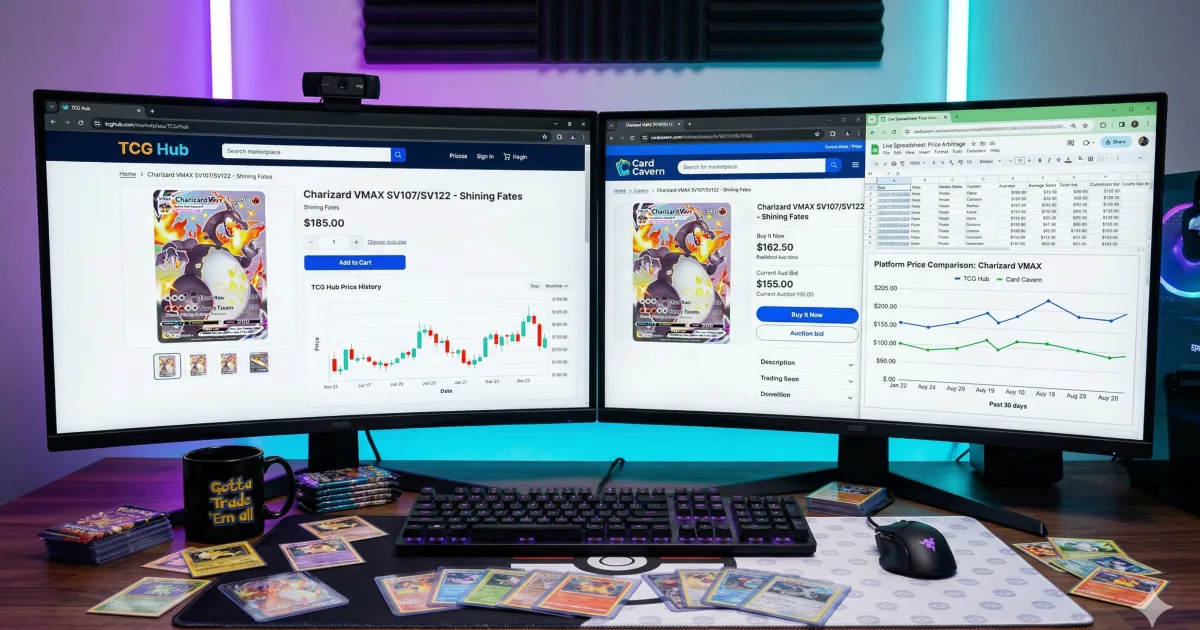
![How Are Pokemon Card Prices Determined? A Complete Guide to Market Mechanics [April 2026]](https://res.cloudinary.com/ddrvtv4ul/image/upload/v1776129602/blog/pokemon-tcg/pokemon-card-prices-market-mechanics.png)
Same card. Same condition. $8.40 on TCGPlayer. $17.50 on eBay. Where does that $9.10 gap come from?
"Supply and demand" is the easy answer. But Pokemon card price formation is far more complex — and far less efficient — than the stock market. That inefficiency is exactly where traders find their edge.
🔍 Detect Pokemon Card Price Gaps in Real Time → GapSense.uk
Why Does the Same Card Have Multiple "Correct Prices"?
In the stock market, there's one price on one exchange. Pokemon cards have no unified exchange. TCGPlayer, eBay, Courtyard, CardMarket — each platform operates as an independent market with its own distinct buyer pool.
TCGPlayer's lowest price is driven by player demand. The core buyer wants the cheapest copy to play in tournaments. eBay skews toward collectors — buyers who will pay up for the card they want. That difference in buyer composition is the structural reason the same card trades at a $5–$10 spread across platforms.
GapSense's latest data (as of April 14, 2026) detects 292 arbitrage opportunities in the market — 79 same-platform flips, 112 price momentum plays. Market inefficiency isn't theory. It's in the numbers.
The 5 Variables That Move Prices
1. Pull Rates
How many packs does it take to pull one copy? If an Illustration Rare appears in 1 out of every 300 packs, physical supply is capped. Right after a new set drops, an opening rush floods supply and prices fall. The bottom typically hits around 3 weeks post-release — when pack openers slow down and the supply tap runs dry.
2. Competitive Meta Shifts
Pokemon cards are part of a trading card game. When a card gets picked up by a tournament-winning deck, it can spike 20–40% within 48 hours of the announcement. Cards that fall out of the meta drop just as fast.
3. Condition Gaps
The price difference between NM (Near Mint) and LP (Lightly Played) isn't fixed — it scales with price tier.
| Price Range | Typical NM vs LP Gap | Trader Implication |
|---|---|---|
| Under $5 | 5–10% | LP purchases barely affect margin |
| $5–$25 | 15–25% | Room to buy LP and sell at NM pricing |
| $25–$100 | 25–40% | Grading starts to make sense here |
| Over $100 | 40–60%+ | Condition becomes the primary price driver |
LP cards in the $5–$25 range sit in a sweet spot where most buyers don't care about condition. That's a hidden profit zone.
4. Cross-Platform Price Propagation Speed
Price moves tend to originate on eBay, then spread to TCGPlayer with a 12–72 hour lag. This week's GapSense data shows Pikachu (SVP) up +61.3% on eBay while WEB3 platform pricing hasn't caught up yet. That propagation lag is the arbitrage window.
5. Psychological Price Points
$9.99 vs $10.01. Two cents apart. Whether your listing appears under TCGPlayer's "lowest price" filter comes down to single-cent pricing. Most sellers aren't thinking about this.
What Nobody Tells You: Listing Count Drives Price
Here's the core insight. Most guides say "prices rise when demand goes up." But in the actual Pokemon card market, supply contraction is the most common driver of price increases.
The "supply_contraction" signals GapSense is currently detecting — cards where listing count is falling while prices hold — number 2 right now. That's not rising demand. That's sellers pulling back. When listings thin out, the price "floor" weakens and 1–2 purchases can move the market.
The flip side: a sudden surge in listing count is a leading indicator of price decline. Just building the habit of watching TCGPlayer listing counts can give you a 24–48 hour read on where prices are heading.
Practical Checklist: Judge a Card's "Fair Market Value" in 10 Minutes
- Check the TCGPlayer lowest price (NM, English)
- Check eBay sold listings (last 30 days) for actual sale prices — not asking prices, sold prices
- Calculate whether the gap is over 15% after fees (TCGPlayer seller fee 12.55%, eBay 12.9% + $1.20 shipping)
- Check the listing count on TCGPlayer — under 10 copies means thin supply and easier price movement
- Check recent tournament results — meta-adopted cards can see demand spikes fast
Doing all 5 steps manually every time is honestly tedious. That's exactly why automation tools have real value.
FAQ
Q: How often do Pokemon card prices change?
Popular cards fluctuate daily. After a new set release or meta shift, prices can move 10–30% within hours. Checking weekly is already too slow.
Q: Why are prices different on TCGPlayer vs eBay?
The buyer pools are different. TCGPlayer is player-driven with intense low-price competition. eBay has a higher collector ratio — buyers who will pay for what they want. That structural difference creates a $5–$15 gap on the same card.
The deeper you understand Pokemon card price formation, the more profit opportunities you can see. Start with the checklist above — pick one card you own and find out what it's actually worth on the market right now.
🔍 Detect Pokemon Card Price Gaps in Real Time → GapSense.uk
🔍 Find Live Pokemon Card Price Gaps Automatically → GapSense.uk
pokemon card pricing · market analysis · Investment · lang:en
Related Articles
![Scarlet & Violet Sets Worth Flipping in 2026 [April Update]](https://res.cloudinary.com/ddrvtv4ul/image/upload/v1776089291/blog/pokemon-tcg/sv-sets-flipping-2026.webp)
Find Live Pokemon Card Price Gaps Automatically
Try GapSense.uk